
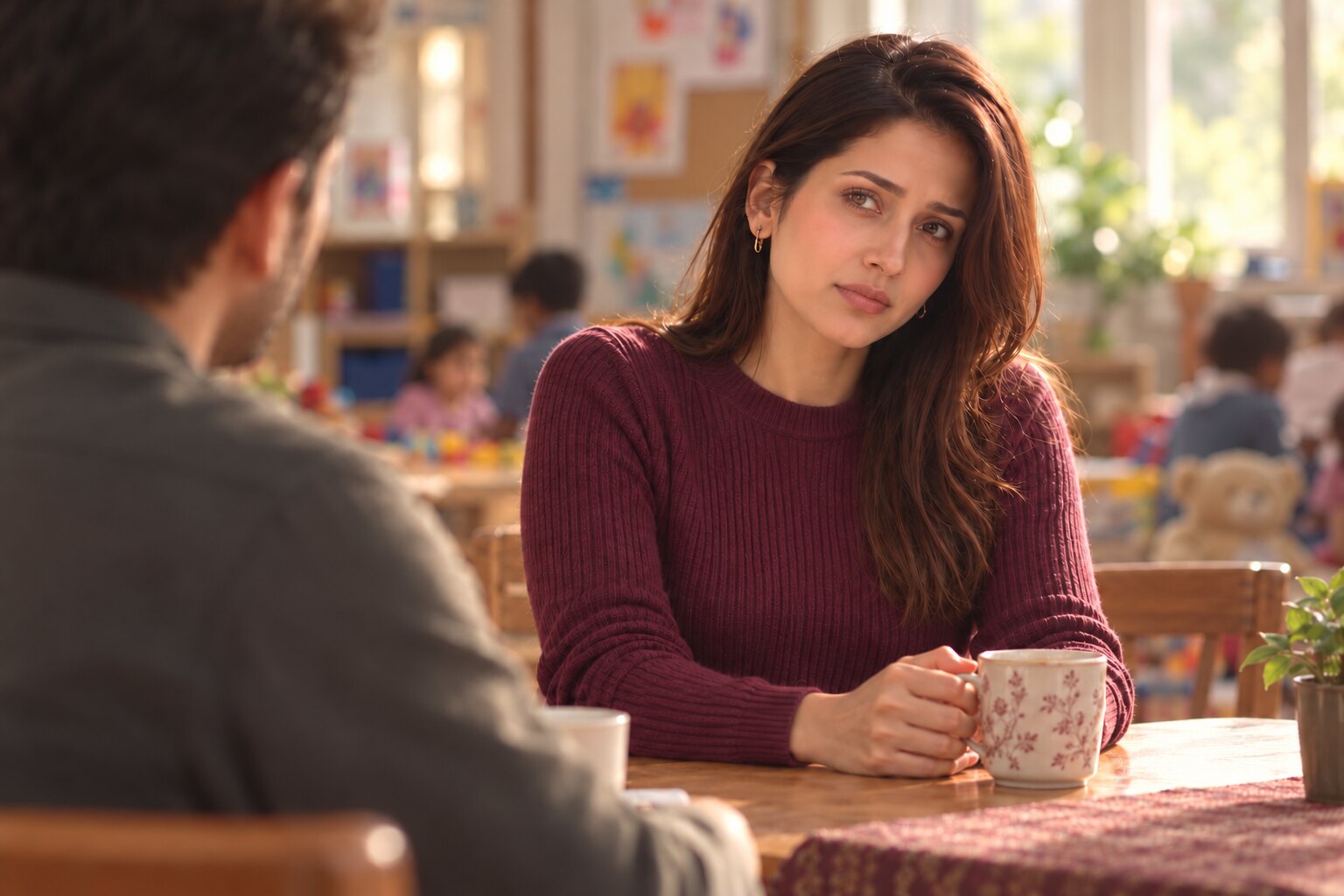
उस रोज़ उसने मन का इक कोना खोल दिया,
कुछ कह दिया, कुछ ख़ामोशी में छोड़ दिया।
मैंने सुना, बिना कोई फ़ैसला किए,
उसकी चुप्पी को अपने अर्थ दिए बग़ैर।
जितना उसने बताया, उतना ही जान सका,
बाक़ी उसकी दुनिया से अनजान ही रहा।
It was during the last few days of our last personal meeting that something changed between us.
Until then, she had always been warm with me. We talked almost every morning, laughed, exchanged stories, and gradually became more comfortable in each other’s company. But there was a part of her that remained guarded—a part I could sense, yet could never quite reach.
This time, she let me see a little further.
Perhaps she had finally reached a point where she could no longer keep everything inside. Perhaps she had begun to trust me enough to speak without carefully measuring every word. Or perhaps, somewhere in her mind, she thought we might never meet again, and that the distance between our worlds would soon return to what it had been before.
I cannot say what made her open up that day. I can only say that she did.
She admitted that she liked talking to me. She liked sharing things with me. She felt comfortable in my company.
More than that, she felt she could speak freely without being judged, manipulated, or hurt.
I was someone from outside her world. I was not part of her family, her household, or the life in which she had to navigate so many unspoken rules. I had no authority over her, no expectations to impose upon her, and no reason to use her vulnerability against her.
Perhaps that distance made it easier for her to trust me.
Whatever the reason, I felt privileged that she had found a little space with me where she could simply be herself.
And then she began telling me about her life.
Not everything. Not yet. But enough to leave me thinking about her long after our conversation ended.
The Price of a Life Others Might Envy
She spoke about the luxuries available to her—the kind of comfort that many people spend their lives working towards, and some can scarcely imagine having. There were helpers, maids, and drivers at her disposal. She could afford things that an ordinary middle-class person might never consider buying.
Yet, as she spoke, I began to understand that material comfort and personal freedom were not the same thing.
She had access to so much, and yet she felt deprived of something far more fundamental: the freedom to live her own life.
She described how her husband could go wherever he wanted, whenever he wanted. He could live his life on his own terms. But she could not even learn to drive. She did not feel she had a say in her own life, not even within the walls of her own home.
She was surrounded by comforts, yet she felt confined.
It was as though she had been given everything that could make life comfortable, except the freedom to decide what that life should look like.
She did not speak of these things with the dramatic gestures one might expect. There were no grand displays of suffering. She was not trying to impress me with her wealth, nor was she presenting herself as someone deserving of sympathy.
In fact, her life at her parents’ home looked remarkably ordinary.
She dressed modestly, behaved naturally, and lived without any apparent desire to display what she possessed. Her manner was so simple that, for a moment, I struggled to reconcile the woman sitting in front of me with the opulent life she was describing.
I had never imagined that someone who appeared so ordinary in her daily life could have access to so much.
But the more I listened, the less I thought about the things she owned. What stayed with me was what she felt she lacked.
Freedom.
The ability to make a choice without needing permission. The ability to go somewhere simply because she wanted to. The ability to shape her own day, her own experiences, perhaps even her own future.
I began to realise that a life can look extraordinarily comfortable from the outside and still feel unbearably restrictive from within.
We often measure a person’s life by what they have. We rarely stop to ask how much of that life they are actually allowed to live.
That day, she made me think about the difference.
I Let Her Speak
I did not question her much while she was opening up.
I listened.
Every now and then, I acknowledged what she was saying, not because I had some wise response ready, but because I did not want to interrupt her flow. I wanted her to continue if she wished. I wanted her to know that she did not have to stop and explain herself just because I was listening.
Sometimes, the most meaningful thing we can offer another person is not advice, reassurance, or a solution. Sometimes, it is the simple assurance that their words have somewhere to go.
I could not change her circumstances. I could not promise her a different life. I could not tell her that everything would be fine when I had no way of knowing whether it would be.
All I could do was listen without trying to take control of her story.
And I wanted to do that well.
As she spoke, I felt that something long held inside her was finally finding a way out. She did not necessarily cry in front of me, but there was a sadness in what she described that seemed to go far beyond the words themselves.
It felt as though she was crying somewhere deep within, in a place where tears did not need to reach the eyes to be real.
I thought I was receiving the sorrow she had been carrying.
But I was wrong to think I understood its depth.
I had heard fragments of her life. I had seen glimpses of her pain. I had begun connecting a few scattered pieces, but I had not yet understood the whole picture. Whatever lay beneath those fragments was deeper than I could comprehend at the time.
I was only beginning to see the surface.
And, somehow, I wanted to understand what lay beneath it.
Why Did I Care So Much?
After our conversation, I found myself asking questions I could not easily answer.
Why was I becoming so emotionally invested in her life?
Why did I want to know more about her? Why did her sadness stay with me? Why did I feel such a strong desire to understand a person who, not long ago, had been a complete stranger?
We belonged to different communities. We had our own families, our own responsibilities, and our own lives. There was no shared history between us, and no clear future that I could imagine for this connection.
We had met by chance.
What, then, was drawing me towards her?
Perhaps the answer lay in something much simpler than I had expected.
Everyone is struggling with something. Some people struggle financially. Some carry physical pain. Others fight battles that remain invisible to everyone around them. I had my own problems, my own responsibilities, and my own share of difficulties. She had hers.
But as I listened to her, I began to feel that the burden she was carrying was heavier than the one I was carrying at that point in my life.
My difficulties were real, but they were not the same as hers. My marriage was not the source of my struggles. She, on the other hand, was describing a life in which she felt she had so little control over her own choices.
And yet, there she was.
She continued to show up. She took care of her children. She spoke warmly, laughed, and carried herself with a composure that could easily conceal what was happening inside her.
I began to admire her in a way I had not expected.
She became my hero.
Not because I knew everything about her. Not because I believed she was perfect. And certainly not because I wanted to rescue her or make myself the answer to her problems.
I admired her because I was beginning to recognise her resilience. I saw someone who, despite whatever she was experiencing, continued to live, care for her children, and find moments of warmth in ordinary days.
Without consciously intending to, I began learning from her.
Her struggles changed the way I looked at my own. They reminded me that people can be carrying burdens we know nothing about. They made me reconsider the size of my problems and the strength it takes to keep moving forward when life feels restrictive or unfair.
Sometimes, meeting someone who is facing a different and perhaps heavier struggle does not make our own pain disappear. It simply helps us see it differently. It reminds us that we are not alone in having a difficult life, and that resilience can exist even where freedom feels limited.
That was what she was teaching me, without ever setting out to teach me anything.
And perhaps that was one of the reasons I grew so attached to her.
A Connection Beyond Appearances
I want to be honest about what I felt, because the purity of this connection matters to me.
She was a beautiful woman. There was no denying that. But her beauty was not what kept me thinking about her. It was not what made me want to hear her stories, understand her circumstances, or sit beside her for a little longer.
What drew me closer was emotional.
I was fascinated by her personality, her openness, her warmth, and the contrast between the life she appeared to lead and the life she described. I wanted to understand the person behind the composure. I wanted to know what she thought about when she was alone, what made her happy, what hurt her, and what she wished she could change.
I wanted to understand her—not possess her.
There is a difference, though I do not claim that human feelings are always simple enough to fit neatly into words.
We were both married. We belonged to different communities. We had met as strangers, and there was no obvious place for this growing attachment in the lives we already had.
But none of that made the emotions I was experiencing unreal.
At that point, what I felt was an emotional connection, an admiration, and a growing tenderness towards someone whose inner world I was only beginning to discover. I was not looking at her vulnerability as an opportunity to get closer to her physically. I was not thinking about what I might receive from her in return.
I wanted to listen. I wanted to understand. And, when she spoke about the things that hurt her, I wished I could make those moments a little less lonely for her.
Perhaps that is what happens when we begin to see someone beyond the labels that usually define them.
Her religion did not disappear. Neither did mine. Our marriages, our responsibilities, and the differences between our lives remained real. But in those moments, they were not the first things on my mind.
I was simply listening to another human being.
A woman who seemed to have so much, yet felt she was missing something essential.
A woman whose smile did not tell me everything.
A woman I had come to care about without fully understanding why.
I cannot claim that every feeling I experienced was free from contradiction. Human attachment is rarely that tidy. But I knew that what mattered most to me then was the person she was allowing me to see, not what I might gain from being allowed to see her.
I wanted the connection to remain a place of comfort, not become another source of pressure in her life.
If she felt safe enough to speak to me, I did not want to be the person who made her regret it.
The Hug I Never Gave Her
As she continued to share fragments of her life, I felt there was still so much she was holding back.
She would tell me one thing, then leave another unsaid. She would reveal a little of what she was experiencing without giving me the full picture. It was the same guardedness I had noticed before, except now I could see that it existed alongside a growing willingness to trust me.
She was speaking, but she was not entirely letting go.
I began to sense that the person sitting in front of me was struggling in ways she could not yet bring herself to explain fully. She appeared composed, but I wondered how much effort that composure required.
I could not know everything she was feeling. I could only listen to what she chose to share and try not to mistake my interpretations for her truth.
Still, there was one thing I felt very strongly.
I wanted to hug her.
Not because I thought a hug would solve anything. Not because I believed I had the right to offer physical comfort simply because she had shared something personal with me.
I wanted to hold her for a moment and let her cry, if crying was what she needed. I wanted her to feel that she did not have to keep herself together every second of every day.
I wanted to offer her the kind of comfort that says, without demanding an explanation, You do not have to pretend that you are fine right now.
But we were in a public place. We were still, in many ways, strangers. Whatever trust had grown between us, I could not assume that she would welcome such a gesture.
The fact that I wanted to hug her did not mean I was entitled to do so.
So I did not.
There was also the practical reality that we were running late. Our conversation could not continue indefinitely, however much I wished it could.
I let the moment pass.
Perhaps she would never know that I had wanted to offer her that comfort. Perhaps, even if she did, she might not have wanted it. I could not decide that for her.
All I could do was respect the boundary between what I felt and what I had the right to do.
And in that moment, respecting that boundary felt more important than acting on the tenderness I felt.
The Puzzle Was Still Incomplete
By then, I had begun to connect some of the dots.
Her guarded expressions. The sadness I sometimes thought I saw in her eyes. The way she described her life. The contrast between her material comforts and her lack of freedom. The fact that she could speak so warmly and still seem to carry something heavy within her.
But the picture was far from complete.
I did not know the full story of her marriage. I did not know everything she had experienced, everything she feared, or everything she had learned to keep to herself. I had only heard the fragments she had chosen to share.
I could speculate. I could try to make sense of what I had heard. But I could not pretend that my guesses were facts.
What I did know was that I wanted to understand her better.
And that desire had begun to occupy more of my thoughts than I was prepared to admit.
After leaving the activity centre, I carried our conversations with me. I would find myself remembering something she had said, wondering what she had meant, or thinking about the things she had not said.
My interest in her life was growing into something intense. I could feel the attachment deepening, even though I had no clear explanation for where it would lead.
Perhaps the uncertainty itself made it stronger. We had no defined relationship, no promises, and no shared plans for a future. We had only the conversations we managed to have, the moments we spent together, and the trust that was slowly taking shape between us.
I did not know what place I occupied in her life.
I knew only that she had begun to occupy a significant place in mine.
And I wanted to understand why.
A Lunch That Never Happened
During our conversation, she told me that she would be dropping her sister off the following day, Saturday, and would return on Monday.
I had been wanting to spend some time with her outside the activity centre. On previous occasions, I had suggested going out together with the children, but she had found reasons to decline.
This time, I asked if I could take her out for lunch before she left for her city.
She agreed.
It was a small thing, perhaps. Just lunch. Nothing more had been promised, and I did not want to read too much into her agreement. Still, I was happy that she had not declined this time.
I looked forward to spending a little more time with her, away from our usual routine. I wanted to listen to her, understand more of her world, and simply enjoy her company before she left.
But that lunch was never going to happen.
I came to know on Saturday itself that she would not be returning as planned.
I had no idea then what this change would mean, or how much the days ahead would alter the course of our story. All I knew was that the little plan I had been looking forward to would remain unfulfilled.
Sometimes, the smallest changes in our plans lead to stories we could never have anticipated.
I had no way of knowing that this was one of those moments.
Not the End of the Story
That was the last time I met her in person.
At least, it was the last time I saw her face-to-face before I began writing this story.
But some connections do not depend on physical presence. Sometimes, the distance between two people grows smaller even when they are no longer sitting across from each other.
I will leave that story for another day.
For now, I return to that last meeting—to the woman who had finally allowed me to see a little more of what she carried within her, and to the feelings I was only beginning to understand myself.
I had gone there knowing her as someone I looked forward to meeting every morning. I left knowing that she had trusted me with parts of herself she had kept guarded.
She had told me she felt comfortable talking to me. She had shared her frustrations, her helplessness, and the contrast between the life she possessed and the life she felt unable to live freely.
I could not solve her problems. I could not change her circumstances. But I could listen, and I could care.
And somewhere along the way, without either of us making any grand declaration, this connection had begun to mean more to me than I could explain.
I still had so much to understand about her. So many unanswered questions. So many pieces of a puzzle that refused to come together.
I thought I was beginning to understand her.
Perhaps I was only beginning to understand how little I knew.
And the story?
It was far from over.